


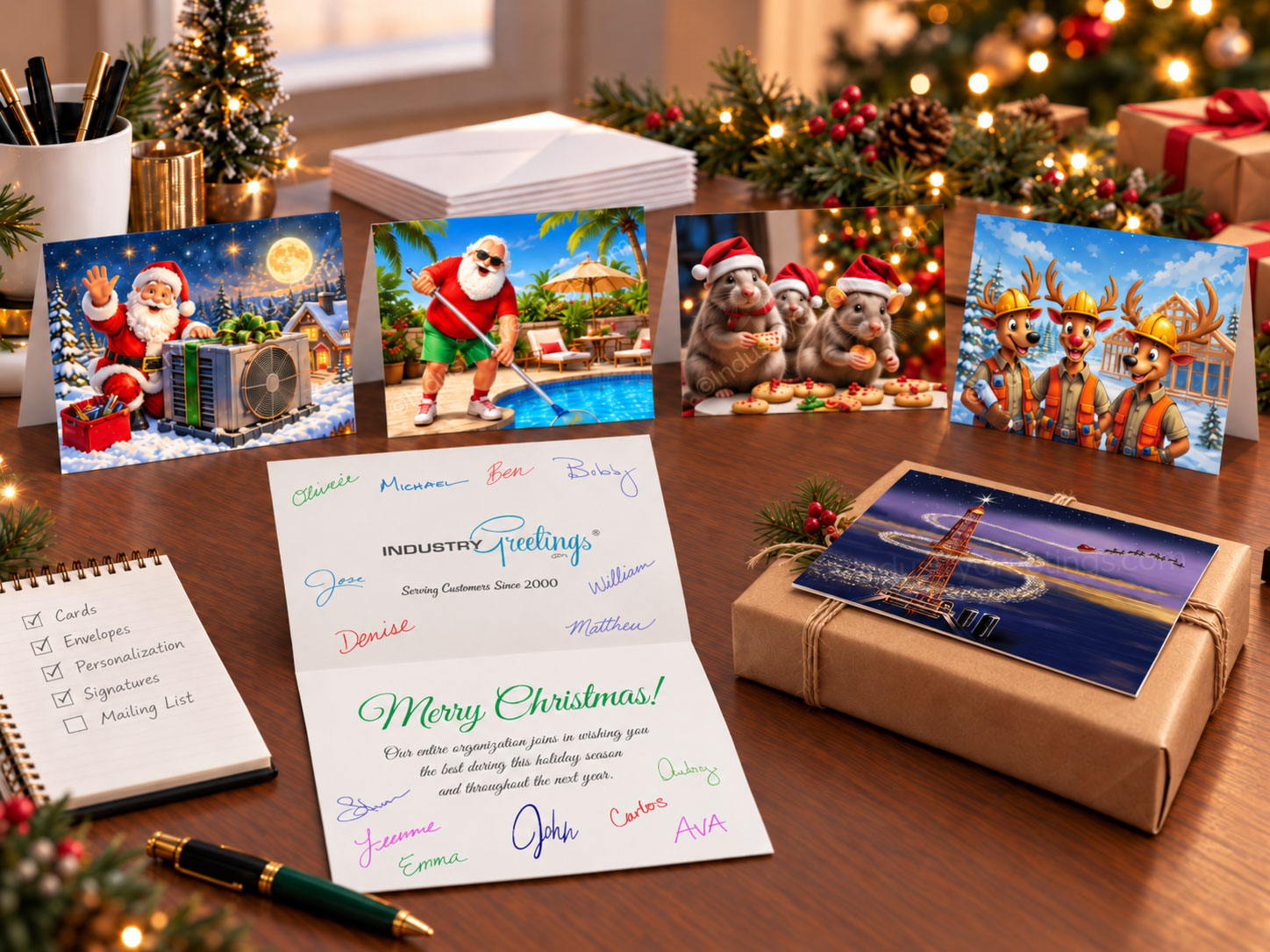
Choosing Christmas cards for your business doesn’t have to mean automatically adding every personalization option available.
In fact, the best card order is usually not the one with the most upgrades. It is the one that puts your money into the details that matter to your customers—or saves your business meaningful time.
And when you start with an industry-specific Christmas card, you already have an advantage.
The artwork itself connects the message to what your company does. A plumbing company can send a card customers immediately associate with plumbing. A landscaper can choose a lawn-care design. An accountant, contractor, trucking company, dentist or automotive repair business can do the same.
That means your card is already doing some of the branding work before you add a logo, signatures or anything else.
From there, the question becomes:
Which upgrades actually add value for your business?
Start With the Built-In Advantage: Your Industry is Already Part of the Card
A traditional business Christmas card may be attractive, but it often has little connection to the company sending it.
An industry-specific card starts differently.
The artwork itself can reinforce what your company does and make the greeting more recognizable when it arrives.
That can be especially useful for businesses whose clients may not need them again for months or years. A customer who sees an electrician-themed, construction-themed or landscaping-themed Christmas card will often connect the greeting with the company before even reading the inside.
So before deciding what else to add, remember:
You are not starting with a generic blank slate.
For some businesses, the industry-specific design plus a company name inside the card may already accomplish exactly what they want.
Want Stronger Brand Recognition? Add Your Logo to the Front
A front logo can be one of the most valuable upgrades when recognition matters.
Consider adding your logo to the front if:
-
- you compete with several similar companies in your market
- customers may not remember your company name immediately
- your logo is already recognizable from trucks, uniforms, signage or advertising
- maintaining a strong branded appearance is important to your business
- you want the recipient to know who sent the card before opening it
The combination can be particularly effective on an industry-specific card.
The artwork says what kind of company you are, while the logo says which company you are.
On the other hand, not every business needs this.
If your customers know you personally, your business name is highly recognizable, or you simply want an economical way to send a thoughtful greeting, adding a front logo may not be necessary.
If Customers Know Your Team, Printed Signatures Make Sense
Signatures make the most sense when the people behind the company are part of the customer relationship.
That could include a small office with long-term employees, an accounting or professional-services firm, a service company whose customers regularly interact with the same staff, a family-owned business, or a company where the idea of “from our whole team” is important. Using first names only is best for visual recognition - especially when there are lots of names.
Printed signatures can give the inside of the card a much more personal appearance without requiring everyone to physically sign hundreds of cards.
They can also save a surprising amount of staff time (which equals labor cost savings). If five employees need to sign 500 cards, that is potentially 2,500 individual signatures, plus the time required to circulate, stack, organize and keep track of the cards without any getting damaged.
Another time-saving approach is to use preprinted signatures with just the owner's signature along with a short personally handwritten note.
Having signatures incorporated into the printed card can eliminate so much extra work.
But again, it isn't necessary for everyone. Many companies may be perfectly well served by simply including a "From all of us at" and the company name into a 2-line personalization as part of the standard greeting cost.
Wearing Too Many Hats? Consider Convenience Upgrades
For many small-business owners, the biggest expense involved in holiday cards is not necessarily printing.
It is time.
Someone has to organize the cards, address envelopes, stuff them, seal them, apply postage and get them into the mail.
And in a small company, that “someone” is often the same person who also answers the phones, schedules jobs, handles customers, manages employees and runs the business.
This is where convenience options can sometimes provide more value than another visual customization.
Peel-and-Seal Envelopes Can Turn a Tedious Job Into a Faster One
Traditional gummed envelopes work perfectly well.
But when you are preparing hundreds of cards, repeatedly moistening and sealing envelope flaps can become a surprisingly unpleasant part of the project.
Peel-and-seal envelopes often make sense when:
-
- you have a larger mailing
- one or two employees will be doing most of the assembly
- you want to complete the mailing quickly
- the cost of your staff completing the mailing project outways the cost of the upgrade.
This is a good example of an upgrade that doesn't make the finished card more decorative at all.
Its value is simply saving labor (costs and headaches) and making the project more enjoyable.
Already Have a Customer List? Recipient Addressing Can Save Hours
If you already maintain customer addresses in Excel or another usable data file, having the recipient information printed on the envelopes can remove one of the most time-consuming steps in a large mailing.
Instead of:
printing labels,
applying labels,
hand-addressing envelopes,
or trying unsuccessfuly to run envelopes through your own office printer,
the envelopes can arrive already addressed with both return address and recipient address .
This option tends to make the most sense when the customer data is already organized and reasonably clean.
The larger the mailing, the greater the potential time savings.
For a business sending 500 holiday cards, eliminating 500 separate addressing tasks can be far more valuable than adding another decorative feature to the card itself.
Mailing Services Can Remove Even More of the Work
Some businesses want the customer-relationship benefit of sending cards but have little interest in turning the office into a temporary mailing department.
In that situation, addressing and mailing services may be the upgrade that provides the greatest value.
Depending on the mailing, services can eliminate several internal steps such as:
-
- addressing envelopes
- inserting cards
- sealing envelopes
- applying postage
- preparing the completed mailing
That allows the company to focus on choosing and personalizing the card but then get back to business and shift the physical mailing work elsewhere.
For qualifying mailings (200+), Presort Standard postage will also reduce postage expense compared with First-Class Mail, although the tradeoff is a little slower delivery time.
That makes advanced planning important.
The least expensive option is not always the one that costs the least per card. Sometimes saving several hours of employee time is the more valuable savings.
Do You Need a Return Address Imprint?
Maybe. Maybe not.
This is exactly the kind of option that should depend on how you actually use the cards.
If you are mailing cards individually to customers, a professionally printed return address can create a polished envelope and save another preparation step.
But suppose you are a pool-service company, landscaper, pest-control company or another service business that plans to hand deliver cards while visiting customers.
In that case, a return-address imprint on the envelope may provide very little practical value.
If you don't need it, don't add it simply because it is available.
Spend that money somewhere that helps—or don't spend it at all.
Sometimes the Best Upgrade Is No Upgrade at All
This is important.
A business does not need an elaborate Christmas-card order for the mailing to be worthwhile.
Imagine a company that simply wants to remind customers:
We're still here, we appreciate your business, and we're thinking of you during the holidays.
That company can choose an industry-specific design, select a standard greeting that already allows for the inclusion of the company name inside.
That's it.
The card is still distinctive.
It still reflects the business.
It still gives the customer a positive reminder of the company.
And it can remain a very economical customer-retention tool.
Adding options should improve the card or simplify the process—not become a requirement for sending one.
Think About What Problem Each Upgrade Solves
A simple way to decide is to ask why you are considering each option.
Need customers to recognize your company quickly?
Consider a front logo.
Customers have relationships with your employees or team?
Consider printed signatures.
You have hundreds of envelopes to seal and very little staff time?
Consider peel-and-seal envelopes.
Your customer addresses are already organized in a spreadsheet or data file?
Consider recipient addressing.
You don't have time to assemble and process a large mailing internally?
Consider mailing services.
Hand delivering the cards?
You may not need envelope imprinting at all.
Just want an affordable annual touchpoint with customers?
An industry-specific card with your company name and a standard greeting may already be exactly enough.
The important question isn't:
“What can I add?”
It is:
“What would actually help my business?”
Branding Upgrades and Time-Saving Upgrades Do Different Jobs
It can also help to divide the options into two groups.
Branding and personalization
These make the greeting more recognizably yours:
-
- industry-specific artwork
- company name
- front logo
- custom message
- printed signatures
Convenience and mailing
These make the project easier to complete:
-
- peel-and-seal envelopes
- recipient addressing
- envelope imprinting
- inserting and sealing
- mailing services
One business may care much more about branding.
Another may already have strong brand recognition but desperately want to avoid spending two days preparing envelopes.
Neither is wrong.
The best value depends on what problem you are trying to solve.
Put Your Money Where It Matters Most
Holiday cards can be as simple or as customized as your business needs.
An industry-specific design already gives you something generic cards cannot: imagery that reflects what your company actually does.
From there, personalization can strengthen recognition, while convenience options can reduce the amount of work required to get the cards into cliets' hands.
You don't need to purchase every available option to send an effective Christmas card from your company.
Choose the upgrades that make your company more recognizable, make the greeting more personal, save meaningful staff time—or solve another real problem for your business.
And if the basic industry-specific card already does what you need?
That's a perfectly good choice too.