


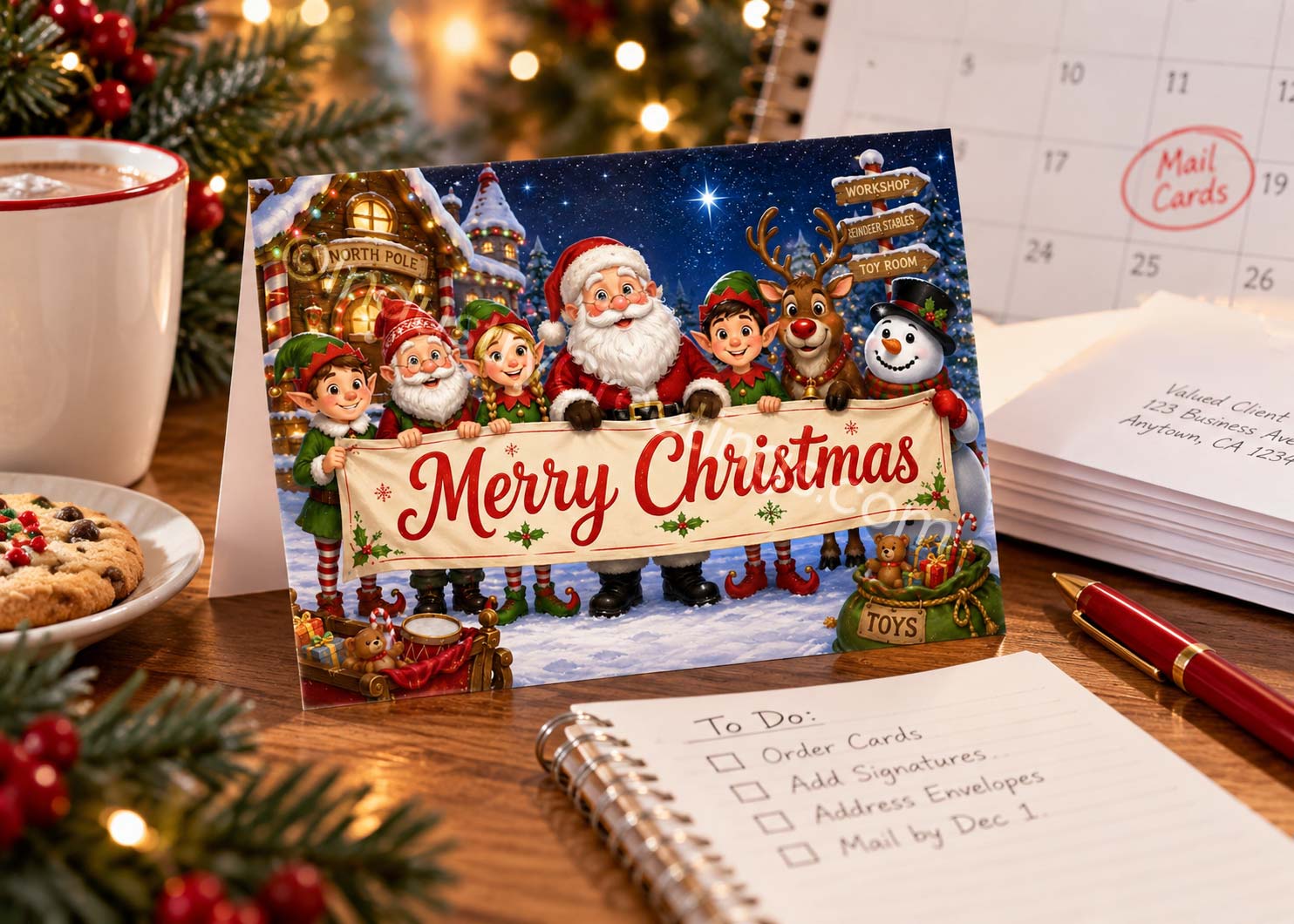
If you want to improve the process and benefit of sending business Christmas cards, substantially, plan backward from when you want your customers to receive them. That said, recognize there is more to the timeline than mailing time. Your cards have to be selected, personalized and produced (physically printed), the finished order has to be shipped to you, and then the cards still need to be signed, addressed, mailed or hand delivered. While there are a lot of moving parts, nothing should feel intimidating or cause you to forgo the most effective marketing campaign your business manages each year.
For businesses that want the best “card real estate,” we generally recommend having business Christmas cards arrive during the first week after Thanksgiving. Your card arrives after the Thanksgiving holiday but before customers are receiving the heaviest volume of December cards, gifts and promotional mail. It also gives professional offices plenty of time to see and enjoy your greeting before employees begin taking vacation or offices reduce their schedules around Christmas.
That doesn’t mean every business needs to follow exactly the same schedule. Who you send cards to—and how you get them there—matters.
Who’s your client?
The right date depends partly on who receives your cards and how they receive them.
Accountants, architects, attorneys or other professional firms, as well as trade businesses that service primarily business clients, may want to be toward the earlier end of the holiday-card season.
While home-service trade businesses and any company whose client base is residential in nature, can have a little more flexibility. Often times this includes landscapers, pool-service companies, pest-control companies, janitorial services and other trade businesses but is just as applicable for professional firms who work directly with families rather than businesses and commercial customers.
How do you distribute your Christmas cards? Do you have staff that hand delivers and needs to make appointments? Do you have regular maintenance crews that see customers weekly/monthly? Are you mailing your cards USPS? Even USPS mailing timeframes change with client base. Are your customers local? National? International? If your mailing list is 200 or more, there are slower but more cost effect solutions for mailing.
Start With the Arrival Date—Then Work Backward
One of the easiest mistakes is thinking only about the day you plan to mail the cards.
There are really three parts to your schedule:
1. Your card order has to be created and produced.
If you're adding a logo, changing a greeting, including signatures or making other customizations, allow time to prepare and approve the order.
2. The finished card order has to reach you.
Your cards don't instantly appear in your office when printing is complete. Shipping time from the manufacturer to your location is a separate part of the schedule.
3. Your cards have to reach your customers.
Once you receive the order, you may still need to sign, address, stuff, stamp and mail the envelopes—or organize hand delivery.
Working backward from the date you want customers to receive their cards makes it much easier to decide when you should actually place your order.
Don't Confuse Shipping Time With Mailing Time
There are actually three separate timelines, and each matter.
First, your completed card order has to travel from us in Southern California to you.
Ground shipping is often the most economical choice, but it takes longer than expedited services. A customer in California naturally has a different transit time from a customer receiving an order in Florida, New York or another part of the country.
Fall and winter weather can also create transportation delays. Severe weather doesn't necessarily have to occur where you live. Storms or other disruptions anywhere along the route can affect a shipment traveling across the country.
Second, processing and readying your cards for mailing. Depending on your mail list, your mail file, the customization and finishing ordered with your cards, this time may include addressing envelopes (return and recipient) either by hand or adhering labels, stuffing, sealing and adding a stamp for each.
Third, is the physical card delivery timeline: getting the individual cards from you to your customers.
Why We Recommend Ordering Earlier Than You Think You Need To
Having your finished Christmas cards in your hands early does not mean you have to mail them early.
It means you control the schedule.
Once the cards are in your possession, you can decide when it makes sense to gather everyone for signing, prepare the envelopes, organize your mailing list or start making deliveries.
Waiting until the last possible moment takes away that flexibility.
An unexpected proof change, production issue, shipping delay, busy workweek or weather event can suddenly turn a pleasant holiday project into one more urgent deadline.
It is much better to have the completed cards waiting for you than to be waiting for the cards.
Order More Cards Than You Think You'll Need
Another common problem we see is customers running out.
Businesses often calculate their current mailing list carefully, order almost exactly that quantity, and then remember additional customers, vendors, employees, referral sources or business contacts after the cards arrive.
Others add new customers during the season or simply underestimate how many cards they will hand out.
That frequently leads to a second order several weeks later—when the holiday calendar is much less forgiving.
Ordering extra cards with your original order gives you flexibility and can help you avoid the time and expense of producing and shipping a small rush reorder later. Industry Greetings card pricing is based on volume so ordering more at once vs 2 smaller orders (and shipping 1x vs 2x) can make a real difference.
It is much easier to have a handful of cards left over than to realize on December 5 that you need another batch.
Build Signing Time Into Your Schedule
For some businesses, printing the cards is the easy part.
Whether signing 50 or 500 cards, the process can become a substantial project.
Whether the entire staff will personally sign, or just an executive, allow enough time for that step. The more people who need to sign, the more opportunity there is for the project to stall on someone's desk.
Another option is to have signatures added as part of the card order.
With Industry Greetings, signatures can be incorporated into the printed inside of the card. That can save considerable staff time while still giving customers a greeting that reflects the people behind the business.
Addressing and Mailing Services Can Save Time Too
Large holiday mailings involve more than cards.
Someone still has to address the envelopes, prepare the mailing and get hundreds or thousands of finished pieces into the mail.
Having envelope addressing and/or mailing services included with your order can remove a significant amount of internal labor.
Postage method also affects timing.
Presort Standard postage can be considerably less expensive for qualifying mailings, but it travels more slowly than First-Class Mail. If saving on postage is a priority, allow the additional mailing time when deciding when your cards should be completed.
The less work your staff has to do, the easier it is to keep your holiday mailing on schedule and keep your business running smoothly during the process.
What If You Order Later in the Season?
Later doesn't automatically mean too late.
Businesses mailing primarily to residential customers often have more flexibility than companies mailing to professional offices. And companies that hand deliver cards during regularly scheduled service visits may be able to continue giving them to customers well into December.
The greeting itself also matters. A card that says Merry Christmas has a more specific seasonal window. A Happy Holidays or Season's Greetings message gives you more flexibility throughout December and through the end of the holiday season if you find you need it.
Give Yourself Options, Not Deadlines
The best holiday-card schedule is one that leaves you with choices.
Order early enough that your cards can arrive before you desperately need them. Order enough that you aren't forced into a late-season reorder. And consider whether printed signatures, addressing or mailing services could remove some of the work from your staff.
Once your completed cards are in your hands, you decide when to tackle the project and when to send them.
That's a much better position than having the holiday-card project suddenly become urgent because production, shipping or some other unexpected delay consumed the time you thought you had.
A little extra planning early in the season gives you more control later—and lets your business Christmas cards feel like the thoughtful customer greeting they were intended to be.